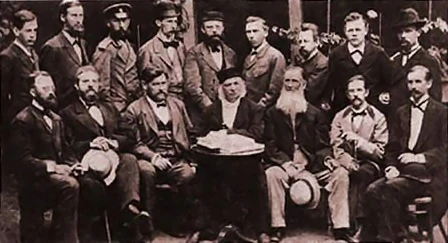
Johannes Kepler
German polymath who formulated laws of planetary motion.

via Wikipedia: Johannes Kepler · see source
Johannes Kepler (27 December 1571 – 15 November 1630) was a German polymath active as an astronomer, mathematician, astrologer, natural philosopher, and music theorist. He is a key figure in the 17th-century Scientific Revolution, best known for his laws of planetary motion and his books *Astronomia nova*, *Harmonice Mundi*, and *Epitome Astronomiae Copernicanae*. The variety and impact of his work made him one of the founders and fathers of modern astronomy, the scientific method, natural science, and modern science. He has also been described as the "father of science fiction" for his novel *Somnium*.
- born
- 27 December 1571
- died
- 15 November 1630
- field
- Astronomy, mathematics, astrology, natural philosophy, music theory, optics
- nationality
- German
- known_for
- Laws of planetary motion, Keplerian telescope, Kepler conjecture, father of mode
Lore & Background
Kepler was born on 27 December 1571 in the Free Imperial City of Weil der Stadt. His parents were Lutheran, but he was likely baptized Catholic, as Protestant baptisms were not permitted there at the time. His father Heinrich was a mercenary who left the family when Johannes was five; his mother Katharina was a healer and herbalist. Born prematurely, Kepler claimed to have been weak and sickly as a child, but he often impressed travelers at his grandfather's inn with his mathematical faculty. At age six, he observed the Great Comet of 1577, writing that he "was taken by [his] mother to a high place to look at it." At age nine, he observed a lunar eclipse, recording that the Moon "appeared quite red." Childhood smallpox left him with weak vision and crippled hands, limiting his observational ability. Kepler attended the Tübinger Stift at the University of Tübingen, studying philosophy under Vitus Müller and theology under Jacob Heerbrand. Under Michael Maestlin, he learned both the Ptolemaic and Copernican systems and became a Copernican. He defended heliocentrism in a student disputation, maintaining the Sun was the principal source of motive power. Despite wanting to become a Lutheran minister, he was denied ordination due to beliefs contrary to the Formula of Concord. In April 1594, at age 22, he accepted a position as teacher of mathematics and astronomy at the Protestant school in Graz. In Graz, Kepler issued official calendars and prognostications that enhanced his reputation as an astrologer. He published *Mysterium Cosmographicum* in 1596. He married Barbara Müller on 27 April 1597; they had two children who died in infancy, then a daughter Susanna (1602), a son Friedrich (1604), and another son Ludwig (1607). Kepler corresponded with Tycho Brahe, who critiqued his use of inaccurate Copernican data. He later became Tycho's assistant in Prague and eventually imperial mathematician to Emperor Rudolf II and his successors Matthias and Ferdinand II. He also taught mathematics in Linz and was an adviser to General Wallenstein. He invented an improved refracting telescope, the Keplerian telescope, which became the foundation of the modern refracting telescope, and improved on Galileo's design.
Reader's Guide
Kepler's significance lies in his transformation of astronomy into a universal mathematical physics, which he called "celestial physics." He described his work as "an excursion into Aristotle's Metaphysics" and "a supplement to Aristotle's *On the Heavens*," treating astronomy as part of a broader mathematical physics. His laws of planetary motion provided one of the foundations for Isaac Newton's theory of universal gravitation. Kepler also did fundamental work in optics, being named the father of modern optics, particularly for his *Astronomiae pars optica*. He invented the Keplerian telescope, improving on Galileo's design, and postulated the Kepler conjecture. His novel *Somnium* earned him the description "father of science fiction." Kepler incorporated religious arguments into his work, motivated by the belief that God created the world according to an intelligible plan accessible through reason. He lived in an era with no clear distinction between astronomy and astrology, and he believed deeply in a connection between the cosmos and the individual, despite mixed feelings about astrology. His legacy as a founder of modern astronomy, the scientific method, natural science, and modern science is widely recognized.
Did You Know?
- Kepler observed the Great Comet of 1577 at age six, writing that he 'was taken by [his] mother to a high place to look at it.'
- At age nine, he observed a lunar eclipse and recorded that the Moon 'appeared quite red.'
- Childhood smallpox left Kepler with weak vision and crippled hands, limiting his ability in observational astronomy.
- Kepler was denied ordination as a Lutheran minister because of beliefs contrary to the Formula of Concord, adopted in 1577.
- He invented the Keplerian telescope, which became the foundation of the modern refracting telescope, improving on Galileo's design.
More in Astronomers And Cosmologists 1-24
Elsewhere in the Astronomers And Cosmologists universe
Spotted an error? Know more?
This is a living reference — every entry is fact-audited, and reader corrections feed straight into our audit queue. Suggest an edit · See this site's audit record