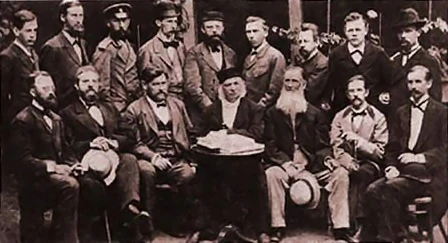
Fred Hoyle
English astronomer who co-founded stellar nucleosynthesis theory.

via Wikipedia: Fred Hoyle · see source
Sir Fred Hoyle (24 June 1915 – 20 August 2001) was an English astronomer. With Margaret and Geoffrey Burbidge and William Alfred Fowler, he formulated the theory of stellar nucleosynthesis in the influential B2FH paper. He held controversial views on some scientific matters — in particular, in his rejection of the "Big Bang" theory (a term he jokingly coined on BBC Radio, though he later denied doing so in derision) in favour of a "steady-state model", and his promotion of panspermia as the origin of life on Earth. He spent most of his working life at St John's College, Cambridge, and served as the founding director of the Institute of Theoretical Astronomy at Cambridge.
- born
- 24 June 1915
- died
- 20 August 2001
- field
- Astronomy
- nationality
- English
- known_for
- Stellar nucleosynthesis (B2FH paper), steady-state model, panspermia
Verified Timeline
Lore & Background
Hoyle was born near Bingley in Gilstead, West Riding of Yorkshire, England. His father Ben Hoyle was a violinist and worked in the wool trade in Bradford, and served as a machine gunner in the First World War. His mother, Mabel Pickard, had studied music at the Royal College of Music in London and later worked as a cinema pianist. Hoyle was educated at Bingley Grammar School and read mathematics at Emmanuel College, Cambridge. In 1936, he shared the Mayhew Prize with George Stanley Rushbrooke. In late 1940, he left Cambridge to go to Portsmouth to work for the Admiralty on radar research, devising a method to get the altitude of incoming aeroplanes and put in charge of countermeasures against the radar-guided guns found on the Graf Spee. Two colleagues in this war work were Hermann Bondi and Thomas Gold, and the three had many discussions on cosmology. On trips to North America, he learned about supernovae at Caltech and Mount Palomar and, in Canada, the nuclear physics of plutonium implosion and explosion, noticing similarity between the two and starting to think about supernova nucleosynthesis. He published his prescient and groundbreaking paper in 1954. He also noticed that one existing process would be made a billion times more productive if the carbon-12 nucleus had a resonance at 7.7 MeV, and persuaded the Caltech nuclear physics group to find the Hoyle state in carbon-12, from which a full theory of stellar nucleosynthesis was developed.
Reader's Guide
After the war ended in 1945, Hoyle returned to Cambridge University as a lecturer at St John's College, Cambridge (where he had been a Fellow since 1939). In 1958, he was appointed Plumian Professor of Astronomy and Experimental Philosophy in Cambridge University. In 1967, he became the founding director of the Institute of Theoretical Astronomy (subsequently renamed the Institute of Astronomy, Cambridge). In 1971, he delivered the MacMillan Memorial Lecture to the Institution of Engineers and Shipbuilders in Scotland on "Astronomical Instruments and their Construction". He was knighted in the 1972 New Year Honours. By 1972, Hoyle had become unhappy with his life in Cambridge; a dispute over election to a professorial chair led him to resign as Plumian professor in 1972, and the following year he also resigned the directorship of the institute. He later wrote: "I do not see any sense in continuing to skirmish on a battlefield where I can never hope to win." After leaving Cambridge, he wrote several popular science and science fiction books, and became chairman of the Anglo-Australian Telescope board in 1973, presiding at its inauguration in 1974 by Charles, Prince of Wales. After his resignation, he moved to the Lake District and occupied his time with treks across the moors, writing books, and working on science ideas that have been largely rejected, including "Stonehenge, panspermia, Darwinism, paleontology, and viruses from space". On 24 November 1997, while hiking near his childhood home in Gilstead, he fell into a steep ravine called Shipley Glen, was located about 12 hours later by a party using search dogs, and was hospitalised for two months with a broken shoulder bone. In 2001, he suffered a series of strokes and died in Bournemouth on 20 August of that year.
Did You Know?
- Hoyle jokingly coined the term 'Big Bang' on BBC Radio, though he later denied doing so in derision.
- He shared the Mayhew Prize in 1936 with George Stanley Rushbrooke.
- During WWII, he devised a method to get the altitude of incoming aeroplanes and countermeasures against radar-guided guns from the Graf Spee.
- He predicted the carbon-12 nucleus would have a resonance at 7.7 MeV, later confirmed experimentally as the Hoyle state.
- On 24 November 1997, he fell into a steep ravine called Shipley Glen and was found 12 hours later by search dogs.
Frequently Asked Questions
Who is Fred Hoyle?
Sir Fred Hoyle (1915–2001) was a British astronomer whose career spanned stellar physics, cosmology, and the origins of life. He is best remembered for his work on how stars forge heavy elements and for his vocal opposition to the Big Bang model.
What is the B2FH paper and why does it matter?
The 1957 B2FH paper, co-authored by Hoyle with Margaret Burbidge, Geoffrey Burbidge, and William Fowler, mapped out the nuclear reactions by which stars produce elements heavier than hydrogen and helium. It remains a cornerstone of modern astrophysics and nuclear theory.
Why did Fred Hoyle reject the Big Bang theory?
Hoyle argued that the universe had always existed in roughly the same state, favoring a steady-state model in which new matter continuously forms as the cosmos expands. He found the idea of a singular explosive beginning physically and philosophically unconvincing.
What did Fred Hoyle say about the origin of life?
He championed the panspermia hypothesis, proposing that the building blocks of life arrived on Earth from outer space rather than arising purely through local chemical processes. This view set him apart from many of his peers in the biology and chemistry communities.
Did Fred Hoyle actually invent the term 'Big Bang'?
Ironically, yes—Hoyle coined the phrase during a BBC radio broadcast in the 1940s, using it with a touch of mockery to describe the rival cosmological model he personally opposed. The label stuck in popular science despite his disapproval of the underlying theory.
More in Astronomers And Cosmologists 25-37
Elsewhere in the Astronomers And Cosmologists universe
Spotted an error? Know more?
This is a living reference — every entry is fact-audited, and reader corrections feed straight into our audit queue. Suggest an edit · See this site's audit record