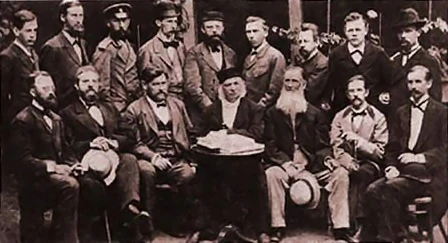
Allan Sandage
American astronomer who determined the first reasonably accurate values for the Hubble constant and the age of the universe.

via Wikipedia: Allan Sandage · see source
Allan Rex Sandage (June 18, 1926 – November 13, 2010) was an American astronomer. He was Staff Member Emeritus with the Carnegie Observatories in Pasadena, California. He determined the first reasonably accurate values for the Hubble constant and the age of the universe. Sandage was one of the most influential astronomers of the 20th century, making contributions to all aspects of the cosmological distance scale, from calibrators within the Milky Way to cosmologically distant galaxies. Throughout the 1950s and well into the 1980s he was regarded as the pre-eminent observational cosmologist.
- born
- June 18, 1926, Iowa City, Iowa, United States
- died
- November 13, 2010, San Gabriel, California, United States
- field
- Observational cosmology
- nationality
- American
- known_for
- First accurate Hubble constant; refining the age of the universe; photometric st
Verified Timeline
Lore & Background
Sandage graduated from the University of Illinois in 1948 and received a PhD from the California Institute of Technology in 1953, with German-born Wilson Observatory-based astronomer Walter Baade as his advisor. During this time he was a graduate student assistant to cosmologist Edwin Hubble, and continued Hubble's research program after Hubble died in 1953. In 1952 Baade announced that two separate populations of Cepheid variable stars in the Andromeda Galaxy doubled the estimated age of the universe from 1.8 to 3.6 billion years. Sandage then showed that astronomers' previous assumption that the brightest stars in galaxies were of equal inherent intensity was mistaken in the case of H II regions, which he found not to be stars and inherently brighter than the brightest stars in distant galaxies. This resulted in another 1.5-fold increase in the calculated age to approximately 5.5 billion years. In 1958 Sandage published the first good estimate for the Hubble constant, revising Hubble's value of 250 down to 75 km/s/Mpc. He later became the chief advocate of an even lower value around 50, corresponding to a Hubble age of around 20 billion years. He performed photometric studies of globular clusters and calculated their age to be at least 25 billion years, leading him to speculate that the universe expanded and contracted with a period of 80 billion years. He co-wrote the paper now referred to as ELS after the authors Olin J. Eggen, Donald Lynden-Bell and Sandage, first describing the collapse of a proto-galactic gas cloud into our present Milky Way Galaxy. He discovered jets erupting from the core of the Cigar Galaxy, caused by massive explosions that have apparently been occurring for at least 1.5 million years.
Reader's Guide
Allan Sandage's significance rests on his foundational contributions to observational cosmology. His 1958 revision of the Hubble constant from 250 to 75 km/s/Mpc brought the value close to today's accepted figure, and his later advocacy for a lower value around 50 reflected his belief that the cosmological constant was zero, requiring a low Hubble constant for the universe's age to be at least as old as its oldest objects (ca. 14 billion years). His 1961 paper 'The Ability of the 200-inch Telescope to Discriminate Between Selected World Models' influenced observational cosmology for at least three decades by specifying the types of observational tests that could be performed with a large telescope, focusing on the search for two parameters: the Hubble constant H0 and the deceleration parameter q0. Sandage's photometric studies of globular clusters gave an age of at least 25 billion years, leading him to propose an 80-billion-year expansion-contraction cycle, though current cosmological estimates are typically around 14 billion years. His co-authorship of the ELS paper advanced understanding of galaxy formation, and his discovery of jets from the Cigar Galaxy highlighted explosive phenomena in galactic cores. Sandage was a prolific researcher, publishing more than 500 papers during his career, and continued active research at the Carnegie Observatories until his death.
Did You Know?
- Sandage was a graduate student assistant to cosmologist Edwin Hubble and continued Hubble's research program after Hubble died in 1953.
- In 1958 Sandage published the first good estimate for the Hubble constant, revising Hubble's value of 250 down to 75 km/s/Mpc.
- Sandage discovered jets erupting from the core of the Cigar Galaxy, caused by massive explosions that have apparently been occurring for at least 1.5 million years.
- He co-wrote the ELS paper (with Olin J. Eggen and Donald Lynden-Bell) describing the collapse of a proto-galactic gas cloud into the Milky Way Galaxy.
- In 1983 Sandage announced he had become a Christian and began to write essays on the subject of religion and science.
Frequently Asked Questions
Who is Allan Sandage?
Allan Rex Sandage (1926–2010) was an American observational cosmologist who spent much of his career at the Carnegie Observatories in Pasadena, California. He is broadly considered one of the most impactful astronomers of the twentieth century.
What is Allan Sandage most famous for?
Sandage is best known for establishing the first reasonably precise measurements of the Hubble constant and for refining estimates of the universe's age. He also carried out extensive photometric work on globular clusters.
Where was Allan Sandage born and where did he pass away?
He was born on June 18, 1926, in Iowa City, Iowa, and died on November 13, 2010, in San Gabriel, California.
What is the Sandage–Loeb test?
The Sandage–Loeb test is a method for gauging the distance to a Type Ia supernova by matching its light curve against a nearby template, letting astronomers measure the universe's expansion rate without climbing the full distance ladder.
Why is Allan Sandage important to the field of cosmology?
By pinning down more reliable values for the Hubble constant and the age of the universe, Sandage gave the field a much firmer quantitative foundation. His globular-cluster studies and the Sandage–Loeb test further shaped how modern cosmologists measure cosmic distances.
More in Astronomers And Cosmologists 1-24
Elsewhere in the Astronomers And Cosmologists universe
Spotted an error? Know more?
This is a living reference — every entry is fact-audited, and reader corrections feed straight into our audit queue. Suggest an edit · See this site's audit record