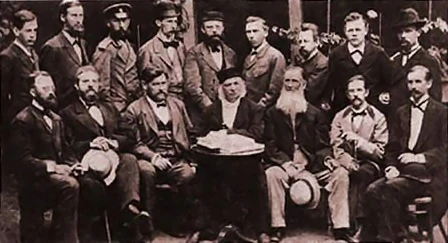
Heinrich Wilhelm Matthias Olbers
German astronomer who discovered asteroids and formulated Olbers's paradox.

Heinrich Wilhelm Matthias Olbers was a German astronomer and physician. He is best known for discovering the asteroids Pallas and Vesta, devising a convenient method for calculating cometary orbits, and formulating Olbers's paradox, which questions the darkness of the night sky in an infinite universe.
- field
- Astronomy
- nationality
- German
- known_for
- Discovery of asteroids Pallas and Vesta; method for calculating cometary orbits; Olbers's paradox
Lore & Background
While there, he studied mathematics with Abraham Gotthelf Kästner. He proposed that the asteroid belt was the remnant of a destroyed planet, though the current view is that tidal effects from Jupiter disrupted planet formation there. He died in Bremen at age 81, was twice married, and one son survived him.
Reader's Guide
Heinrich Wilhelm Matthias Olbers made lasting contributions to astronomy through both observational discoveries and theoretical insights. This paradox influenced later thinking about the structure and age of the cosmos. His recognition of Friedrich Wilhelm Bessel's early work also helped advance celestial mechanics. A statue in Bremen commemorates him.
Frequently Asked Questions
What asteroids did Olbers discover?
Olbers identified both Pallas and Vesta, two of the largest rocky bodies in the asteroid belt between Mars and Jupiter. His observations of these objects helped confirm that an entire population of small bodies occupied that region of the solar system.
What is Olbers's paradox?
It is the puzzle of why the night sky is dark if the universe is truly infinite and uniformly filled with stars, since every line of sight should eventually land on a stellar surface. Olbers raised this question in the early 1800s, and its eventual resolution pointed toward the finite age and expansion of the cosmos.
How did Olbers improve the calculation of cometary orbits?
He devised a streamlined mathematical procedure that let astronomers determine a comet's orbital elements from just a handful of observations. The method became a widely used practical tool for tracking newly discovered comets throughout the nineteenth century.
More in Astronomers And Cosmologists 25-37
Elsewhere in the Astronomers And Cosmologists universe
Spotted an error? Know more?
This is a living reference — every entry is fact-audited, and reader corrections feed straight into our audit queue. Suggest an edit · See this site's audit record