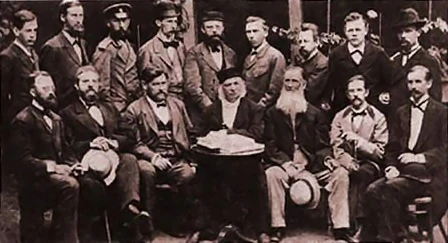
Fritz Zwicky
Swiss astronomer who pioneered dark matter and supernova theory.

via Wikipedia: Fritz Zwicky · see source
Fritz Zwicky was a Swiss astronomer who worked most of his life at the California Institute of Technology in the United States. He made many important contributions in theoretical and observational astronomy, including being the first to propose supernovas as giant explosions at the end of a star's life and neutron stars as the remnants left over after supernovas. In 1933, Zwicky proposed that unseen dark matter would explain the much higher mass required to explain velocity dispersion in the Coma Cluster, compared to mass calculated from luminosity data.
- born
- February 14, 1898
- died
- February 8, 1974
- field
- Astronomy
- nationality
- Swiss
- known_for
- Proposing supernovas and neutron stars, dark matter, gravitational lenses, coini
Verified Timeline
Lore & Background
Fritz Zwicky was born in Varna, Bulgaria, on February 14, 1898, to a Swiss father and Czech mother. At age six he was sent to his paternal grandparents in Glarus, Switzerland, to study commerce, but his interests shifted to math and physics. He received an advanced education at the Swiss Federal Polytechnic (today known as ETH Zurich) in Zürich, finishing in 1922 with a Dr. sc. nat. degree with a thesis titled 'Zur Theorie der heteropolaren Kristalle'. In 1925, Zwicky emigrated to the United States to work with Robert Millikan at Caltech after receiving a Rockefeller Foundation fellowship, and had an office down the hall from Robert Oppenheimer. He was appointed Professor of Astronomy at Caltech in 1942. He also worked as a research director/consultant for Aerojet Engineering Corporation from 1943 to 1961, and as a staff member of Mount Wilson Observatory and Palomar Observatory for most of his career. He developed some of the earliest jet engines and holds more than 50 patents, many in jet propulsion. He invented the Underwater Jet. An example of his WWII rocket propulsion work is a patent on a nitromethane engine filed by a collective of Zwicky and three other Aerojet employees in March 1944. Zwicky died in Pasadena, California on February 8, 1974, and was buried in Mollis, Switzerland.
Reader's Guide
Fritz Zwicky's significance lies in his foundational contributions to modern astrophysics. Together with Walter Baade, he coined the term 'supernova' in 1934 and hypothesized that supernovae were the transition of normal stars into neutron stars, as well as the origin of cosmic rays. He started looking for supernovae and found a total of 120 by himself over 52 years (SN 1921B through SN 1973K), a record that stood until 2009. In 1933, Zwicky was the first to use the virial theorem to discover a gravitational anomaly in the Coma galaxy cluster, concluding that 'dark matter is present in much greater amount than luminous matter'. In 1937, he posited that galaxies could act as gravitational lenses by the previously discovered Einstein effect, confirmed in 1979 with the 'Twin Quasar' Q0957+561. When Edwin Hubble discovered a linear relationship between distance and redshift, Zwicky pointed out discrepancies and proposed a 'tired light' alternative, though cosmological redshift is now understood as a consequence of the expansion of space. From 1961 to 1968, Zwicky and colleagues published the comprehensive six-volume 'Catalogue of Galaxies and of Clusters of Galaxies'. The Fritz Zwicky Stiftung (Foundation) was established in Switzerland to carry on his ideas relating to 'Morphological analysis'.
Did You Know?
- Zwicky coined the term 'supernova' in 1934 with colleague Walter Baade.
- He discovered 120 supernovae by himself over 52 years, a record until 2009.
- Zwicky invented the Underwater Jet and holds more than 50 patents, many in jet propulsion.
- He was critical of religion and considered it unacceptable to attribute natural phenomena to God.
- One of his favorite insults was to refer to people he did not like as 'spherical bastards'.
Frequently Asked Questions
Who is Fritz Zwicky?
Fritz Zwicky (1898–1974) was a Swiss-born astronomer who spent the majority of his career at the California Institute of Technology. He is widely regarded as one of the most forward-thinking theoretical astronomers of the twentieth century.
What is Fritz Zwicky most famous for?
He is best known for coining the term 'supernova,' proposing that neutron stars form as the collapsed cores of those explosions, and first suggesting the existence of dark matter. He also contributed to the theory of gravitational lensing.
How did Fritz Zwicky propose the existence of dark matter?
In 1933, while studying the Coma Cluster, Zwicky noticed that the velocities of its galaxies implied far more mass than could be accounted for by visible light alone. He concluded that a large amount of unseen matter must be present to hold the cluster together gravitationally.
What was Fritz Zwicky's contribution to supernova and neutron star theory?
He was the first astronomer to describe supernovas as the catastrophic final explosions of massive stars and to predict that the dense remnants left behind would be neutron stars. This laid the groundwork for later discoveries of pulsars and neutron star observations.
Where did Fritz Zwicky conduct his research?
Although born in Switzerland, Zwicky carried out nearly all of his professional work at the California Institute of Technology in the United States, where he was based for most of his adult career.
More in Astronomers And Cosmologists 25-37
Elsewhere in the Astronomers And Cosmologists universe
Spotted an error? Know more?
This is a living reference — every entry is fact-audited, and reader corrections feed straight into our audit queue. Suggest an edit · See this site's audit record