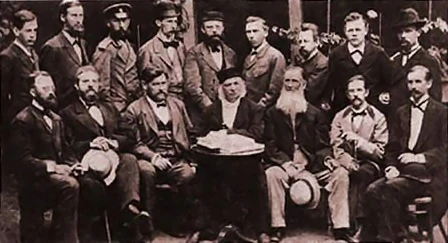
Hugh Everett III
American physicist who proposed the many-worlds interpretation of quantum mechanics.

via Wikipedia: Multiverse · see source
Hugh Everett III was an American physicist who proposed the relative state interpretation of quantum mechanics, which later became the basis of the many-worlds interpretation (MWI). His work dropped the wave function collapse postulate and incorporated the observer into the same quantum state as the observation result, though it was largely disregarded until near the end of his life.
- field
- Physics
- nationality
- American
- known_for
- Relative state interpretation of quantum mechanics, many-worlds interpretation
Lore & Background
area. His parents separated when he was young, and he was raised by his father and stepmother from age seven. Everett received a National Science Foundation fellowship to attend Princeton University, where he started in mathematics under Albert W. Tucker but drifted into physics.
Reader's Guide
Hugh Everett III's most significant contribution is the relative state interpretation of quantum mechanics, which later became the many-worlds interpretation (MWI). This approach eliminated the wave function collapse postulate and treated the observer as part of the same quantum state as the observation result, with the quantum statistic becoming a measure of branching of the universal wave function. Although his work was largely disregarded during his lifetime, it gained credibility with the discovery of quantum decoherence in the 1970s and has received increased attention in recent decades, making MWI one of the important interpretations of quantum mechanics. Everett's career after physics focused on defense analysis and consulting. He worked on classified studies for the U.S. government, including the Minuteman missile project and nuclear fallout distribution. He also founded small companies that applied military modeling to civilian problems and conducted research on affirmative action programs. His work continues to influence both physics and philosophy of science.
Did You Know?
- At age 12, Everett wrote to Albert Einstein asking whether the universe was maintained by something random or unifying; Einstein replied, calling him a 'very stubborn boy.'
- After leaving physics, Everett worked on classified studies for the U.S. government, including the Minuteman missile project and nuclear fallout distribution.
Frequently Asked Questions
Who is Hugh Everett III?
He was an American physicist (1930–1982) best known for formulating the relative state interpretation of quantum mechanics, the theoretical groundwork behind what is now widely called the many-worlds interpretation.
What exactly did Everett propose in his 1957 dissertation?
Everett argued that the wave function never undergoes a discrete collapse and that the measuring observer should be treated as part of the same quantum state as the system under observation. By doing so, he removed the separate collapse postulate that had been a sticking point in quantum theory since the 1920s.
Why was Everett's work ignored for so many years?
The physics community of the 1950s, firmly anchored in the Copenhagen view, largely dismissed his dissertation as overly philosophical and disconnected from experimental practice. It was not until the late 1970s and early 1980s that his ideas began to receive serious engagement from working physicists.
How did Everett's life and career end?
He died on July 19, 1982, just as his relative-state framework was starting to gain broad academic recognition. He did not live to witness the many-worlds interpretation become one of the standard interpretations taught in quantum-mechanics courses worldwide.
Why does Everett's work matter to modern cosmology?
By treating the observer as part of the universal quantum state and eliminating a special collapse rule, his framework gives cosmologists a fully unitary way to apply quantum mechanics to the entire universe. This makes it a natural fit for questions about the quantum origin and large-scale evolution of the cosmos.
More in Astronomers And Cosmologists 1-24
Elsewhere in the Astronomers And Cosmologists universe
Spotted an error? Know more?
This is a living reference — every entry is fact-audited, and reader corrections feed straight into our audit queue. Suggest an edit · See this site's audit record