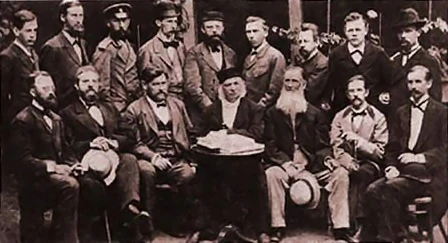
Edward Charles Pickering
Director of Harvard College Observatory who oversaw the Harvard Computers.

via Wikipedia: Antonia Maury · see source
He is known for his work on stellar spectra and for overseeing the Harvard Computers, a group of female astronomers and human computers. The source does not provide details about his early life, education, or specific discoveries beyond his role at the observatory and his relationship with Antonia Maury.
- known_for
- Direction of Harvard College Observatory; Harvard Computers
Verified Timeline
Lore & Background
Pickering was the director of the Harvard College Observatory during the time Antonia Maury worked there as one of the Harvard Computers. Maury's pay was 25 cents an hour, half the amount paid to men at that time. Authors of a book on the Harvard College Observatory described Maury as 'the most original as well as the most elusive personality among the women astronomers at Harvard' due to her strong independence and disapproval of Pickering's undermining of the group's work. In 1887, Pickering had found the first spectroscopic binary star, ζ1 Ursae Majoris (Mizar A). Maury was asked to determine its orbit, which she did. When the discovery was announced, Pickering presented it to the National Academy of Sciences on November 13, 1889, and published a paper 'On the Spectrum of Zeta Ursae Majoris' in 1890. In both cases the only mention of Maury was a single line, stating that 'a careful study of the results has been made by Miss. A. C. Maury, a niece of Dr. Draper'. The sole author credit was given as Pickering. Pickering and others at the observatory disagreed with Maury's system of classification and explanation of differing line widths, and refused to use it. It was partly in response to this negative reaction to her work that she decided to leave the observatory.
Reader's Guide
Pickering's management of the Harvard College Observatory involved assigning women like Antonia Maury to process astronomical data as Harvard Computers. Maury was assigned in 1888 to observe stellar spectra of bright stars in the northern celestial hemisphere and catalog them, contributing to the construction of the Henry Draper Catalogue. The Harvard Observatory staff used an alphabetical system of classification designed by Williamina P. Fleming and Annie Jump Cannon, which Maury found inadequate and replaced with her own more detailed system. Pickering disagreed with Maury's system and refused to use it. When Maury left the observatory in 1891 and later returned in 1893 and 1895, she published her observations in 1897 as 'Spectra of Bright Stars Photographed With the 11-Inch Draper Telescope As Part of the Henry Draper Memorial and Discussed by Antonia C. Maury Under the Direction of Edward Charles Pickering'. This was the first observatory publication to have a woman's name in the title. After Pickering's death, his successor Harlow Shapley gave Maury credit for her work, which was published under her own name.
Did You Know?
- Antonia Maury's pay as a Harvard Computer was 25 cents an hour, half the amount paid to men at that time.
- When Pickering announced the discovery of the first spectroscopic binary star in 1889, he gave sole author credit to himself and mentioned Maury only as 'a niece of Dr. Draper'.
- Maury's 1897 publication was the first Harvard College Observatory publication to have a woman's name in the title.
- Pickering and others at the observatory disagreed with Maury's detailed system of stellar classification and refused to use it.
- It was only after Pickering's death, under director Harlow Shapley, that Maury was given credit for her work and allowed to publish under her own name.
Frequently Asked Questions
Who is Edward Charles Pickering?
Edward Charles Pickering (1846–1919) was an American astronomer and physicist best remembered for his long tenure as director of Harvard College Observatory, a post he held from 1877 until his death.
What are Edward Charles Pickering's key roles and achievements?
He independently identified the first spectroscopic binary stars alongside Carl Vogel, pushed forward photographic methods for collecting stellar spectra, and championed the development of a systematic stellar classification scheme. He also oversaw the Harvard Computers, a team of women assistants whose cataloguing work produced significant astronomical discoveries.
How does Edward Charles Pickering's story end?
Pickering remained at the helm of Harvard College Observatory right up until his death on February 3, 1919, meaning his career as a director and researcher concluded in his final days at the institution he had led for over four decades.
Why is Edward Charles Pickering important to astronomy?
His commitment to photographic spectroscopy transformed how stellar data was gathered and organized, and his support for the Harvard Computers helped build the large-scale spectral catalogues that became foundational to modern stellar astronomy.
What is Edward Charles Pickering most known for?
Fans and historians typically cite his independent discovery of spectroscopic binary stars, his advancement of stellar classification, his decades-long leadership of Harvard College Observatory, and his mentorship of the Harvard Computers as his defining legacy.
More in Astronomers And Cosmologists 25-37
Elsewhere in the Astronomers And Cosmologists universe
Spotted an error? Know more?
This is a living reference — every entry is fact-audited, and reader corrections feed straight into our audit queue. Suggest an edit · See this site's audit record