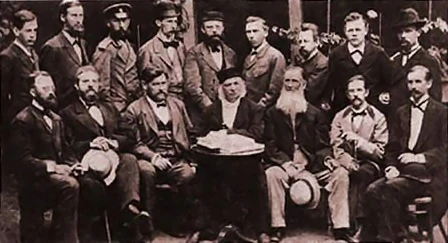
Georges Lemaître
Belgian priest and physicist who proposed the Big Bang theory.

Georges Henri Joseph Édouard Lemaître was a Belgian Catholic priest, theoretical physicist, and mathematician. He made major contributions to cosmology and astrophysics, most notably as the first to argue that the recession of galaxies is evidence of an expanding universe and to propose the hypothesis of the primeval atom, now regarded as the first formulation of the Big Bang theory.
- born
- 17 July 1894
- died
- 20 June 1966
- field
- Cosmology, astrophysics, theoretical physics, mathematics
- nationality
- Belgian
- known_for
- Proposing the expanding universe and the Big Bang theory (hypothesis of the prim
Verified Timeline
Lore & Background
Georges Lemaître was born in Charleroi, Belgium, the eldest of four children of Joseph Lemaître, a prosperous industrialist who owned a glassworks factory, and Marguerite née Lannoy, daughter of a brewer. He studied engineering at the Catholic University of Louvain starting in 1911, but interrupted his studies in 1914 to volunteer for the Belgian army during World War I. He participated in the Battle of the Yser and later received the Belgian War Cross with bronze palm from King Albert I. After the war, he abandoned engineering for physics and mathematics, earning his doctorate in science in 1920 with a thesis on the approximation of functions of several real variables. He was ordained a priest on 22 September 1923 by Cardinal Mercier. With Cardinal Mercier's support, he traveled to England, working with Arthur Eddington at the University of Cambridge in 1923–1924, and to the United States, working with Harlow Shapley at the Harvard College Observatory and at MIT in 1924–1925. Lemaître became a professor of physics at Louvain from 1927 until his retirement in 1964. He was a pioneer in using computers in physics research and, with Manuel Sandoval Vallarta of MIT, showed that cosmic rays are deflected by Earth's magnetic field and must carry electric charge. He also argued for including a positive cosmological constant in the Einstein field equations to help reconcile the age of the universe inferred from the Hubble–Lemaître law with the ages of the oldest stars and the abundances of radionuclides. Lemaître remained a secular priest of the Archdiocese of Mechelen until his death. He was made an honorary canon of St. Rumbold's Cathedral in 1935. In 1960, Pope John XXIII appointed him as Domestic Prelate, entitling him to be addressed as 'Monsignor,' and in that same year he was appointed president of the Pontifical Academy of Sciences, a post he occupied until his death. He received the first Eddington Medal of the Royal Astronomical Society in 1953 for his work on the expansion of the universe.
Reader's Guide
Georges Lemaître's significance lies in his foundational role in modern cosmology. He was the first to argue that the recession of galaxies is evidence of an expanding universe and to connect the observational Hubble–Lemaître law with the solution to the Einstein field equations for a homogenous and isotropic universe. His hypothesis of the primeval atom became the first formulation of the Big Bang theory. Lemaître also advanced astrophysics by demonstrating, with Manuel Sandoval Vallarta, that cosmic rays are deflected by Earth's magnetic field and must carry electric charge. He argued for including a positive cosmological constant in the Einstein field equations, both for conceptual reasons and to reconcile the age of the universe with the ages of stars and radionuclides. Lemaître opposed the idea that faith and science are opposed, but also acknowledged that concordism was invalid, stating: 'Should a priest reject relativity because it contains no authoritative exposition on the doctrine of the Trinity? Once you realize that the Bible does not purport to be a textbook of science, the old controversy between religion and science vanishes.' His legacy endures as a pioneer who combined rigorous scientific inquiry with his religious vocation.
Did You Know?
- Lemaître was one of only five rank-and-file troops to receive the Belgian War Cross with bronze palm from King Albert I after World War I.
- During a leave in World War I, Lemaître visited the French Catholic writer Léon Bloy and shared an essay attempting to reconcile Genesis with modern science; Bloy advised him to study the Church Fathers.
- Lemaître's 1927 paper on the expanding universe had little initial impact because the Annales de la Société Scientifique de Bruxelles were not widely read outside Belgium.
- Lemaître was a member of the Fraternité sacerdotale des Amis de Jésus, a priestly fraternity created by Cardinal Mercier, and took vows of chastity, poverty, obedience, and a special vow of immolation.
- In 1960, Pope John XXIII appointed Lemaître as Domestic Prelate, entitling him to be addressed as 'Monsignor,' and he served as president of the Pontifical Academy of Sciences from 1960 until his death.
Frequently Asked Questions
Who is Georges Lemaître?
Georges Lemaître was a Belgian Catholic priest, mathematician, and theoretical physicist who lived from 1894 to 1966. He is best remembered as the scientist who first articulated the idea that the universe is expanding and that it began from a single 'primeval atom' state.
What is Georges Lemaître's most famous contribution to science?
He was the first to interpret the observed recession of galaxies as proof that space itself is stretching, and he proposed the 'primeval atom' hypothesis, which is now recognized as the earliest formulation of the Big Bang theory.
Was Georges Lemaître both a priest and a working scientist?
Yes, he was ordained as a Catholic priest while simultaneously pursuing a full career in theoretical physics and mathematics. His dual identity as a clergyman and a leading cosmologist made him a uniquely prominent figure in the history of science.
When was Georges Lemaître born and when did he die?
He was born on 17 July 1894 in Belgium and passed away on 20 June 1966. His full name was Georges Henri Joseph Édouard Lemaître.
Why is Georges Lemaître considered so important in the history of cosmology?
Before his work, the prevailing view was that the universe was static and eternal. By arguing that galaxies are receding because space itself is stretching and by proposing a single origin event for all matter, he fundamentally reshaped how humanity understands the cosmos.
More in Astronomers And Cosmologists 25-37
Elsewhere in the Astronomers And Cosmologists universe
Spotted an error? Know more?
This is a living reference — every entry is fact-audited, and reader corrections feed straight into our audit queue. Suggest an edit · See this site's audit record