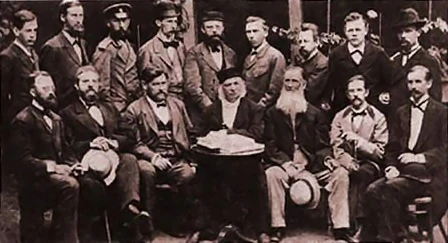
Henry Norris Russell
American astronomer who co-created the Hertzsprung–Russell diagram.

Russell spent most of his career at Princeton University, where he served as professor and director of the Princeton University Observatory.
- field
- Astronomy
- nationality
- American
Lore & Background
Edmondson in the 1930s. The textbook popularized the idea that a star's properties were largely determined by its mass and chemical composition, known as the Vogt–Russell theorem. In his paper, Russell credited Payne with discovering that the Sun had a different chemical composition from Earth but never shared the rewards of the fame he readily accepted for her work.
Reader's Guide
Henry Norris Russell's significance lies in his foundational contributions to stellar astronomy. Russell's textbook, co-authored with Dugan and Stewart, shaped astronomical education for two decades and promoted the Vogt–Russell theorem linking a star's properties to its mass and composition.
Did You Know?
- Russell dissuaded Cecilia Payne-Gaposchkin from concluding the Sun's composition differed from Earth's, later realizing she was correct.
Frequently Asked Questions
Why is Henry Norris Russell considered important in the history of astronomy?
His co-creation of the H-R diagram gave the field a unifying visual framework for classifying stars and tracing their life cycles. His separate contribution of LS coupling also shaped how physicists describe electron interactions in multi-electron atoms, extending his influence well beyond pure observational astronomy.
More in Astronomers And Cosmologists 25-37
Elsewhere in the Astronomers And Cosmologists universe
Spotted an error? Know more?
This is a living reference — every entry is fact-audited, and reader corrections feed straight into our audit queue. Suggest an edit · See this site's audit record