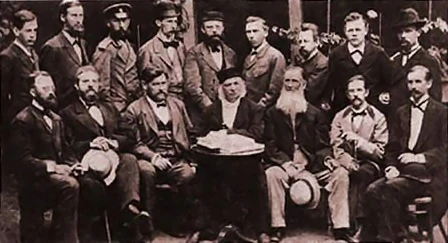
George Ellery Hale
Founder of Mount Wilson Observatory and builder of the Hooker Telescope.

George Ellery Hale was an American astrophysicist who founded and directed the Mount Wilson Observatory, where Edwin Hubble later made his landmark discoveries. Hale built the 100-inch (2.5 m) Hooker Telescope at Mount Wilson, then the world's largest, which Hubble used to identify cepheid variables in nebulae and prove they were galaxies beyond the Milky Way. Hale also built the 40-inch refractor telescope at Yerkes Observatory in 1897, which Hubble used during his doctoral studies. Later, Hale constructed the 200-inch (5.1 m) reflector Hale Telescope at Palomar Observatory, which Hubble became the first astronomer to use shortly before his death.
- field
- Astrophysics
- nationality
- American
Verified Timeline
Lore & Background
George Ellery Hale founded the Mount Wilson Observatory near Pasadena, California, and served as its director. He built the 100-inch (2.5 m) Hooker Telescope there, completed around the time of Hubble's arrival in 1919, making it the world's largest telescope at that time. Hale also constructed the 40-inch refractor telescope at Yerkes Observatory in 1897, which Hubble used during his graduate studies at the University of Chicago's Yerkes Observatory. Later, Hale built the 200-inch (5.1 m) reflector Hale Telescope at Palomar Observatory near San Diego, California. Hubble became the first astronomer to use this newly completed giant telescope shortly before his death in 1953. Hale offered Hubble a staff position at Mount Wilson in 1919, and Hubble remained on staff there until his death.
Reader's Guide
Hale's significance in Hubble's story is direct and practical. He built the telescopes that made Hubble's discoveries possible. The 100-inch Hooker Telescope at Mount Wilson allowed Hubble to identify cepheid variables in the Andromeda Nebula and Triangulum Nebula in 1924, proving they were galaxies outside the Milky Way. The 40-inch refractor at Yerkes, built by Hale in 1897, gave Hubble access to a major instrument during his doctoral studies. Hale also founded the Mount Wilson Observatory and hired Hubble in 1919. Later, Hale's 200-inch Hale Telescope at Palomar was used by Hubble just before his death. Without Hale's vision and engineering, Hubble would not have had the tools to establish extragalactic astronomy and Hubble's law.
Did You Know?
- George Ellery Hale built the 100-inch Hooker Telescope at Mount Wilson, which was the world's largest telescope when completed around 1919.
- Hale also built the 40-inch refractor telescope at Yerkes Observatory in 1897, which Edwin Hubble used during his doctoral studies.
- Hale constructed the 200-inch Hale Telescope at Palomar Observatory, which Hubble became the first astronomer to use shortly before his death in 1953.
- Hale offered Edwin Hubble a staff position at Mount Wilson Observatory in 1919, where Hubble remained until his death.
- The 200-inch reflector at Palomar is named the Hale Telescope after George Ellery Hale.
Frequently Asked Questions
Who is George Ellery Hale?
He was an American astrophysicist who lived from 1868 to 1938 and dedicated his career to advancing solar physics and large-scale telescope construction. He is widely regarded as one of the most influential figures in twentieth-century observational astronomy.
What is George Ellery Hale's most notable scientific discovery?
Hale identified the presence of magnetic fields within sunspots, a finding that fundamentally changed how scientists understood solar activity. This breakthrough laid the groundwork for the entire field of solar magnetism.
Which major telescopes did George Ellery Hale help build?
He oversaw the design and construction of several landmark instruments, including the 40-inch refractor at Yerkes, the 60-inch and 100-inch reflectors at Mount Wilson, and the 200-inch reflector at Palomar. These telescopes dominated astronomical research for decades.
When and where was George Ellery Hale born?
He was born on June 29, 1868, in Chicago, Illinois. He later spent much of his career in California, where he died in Pasadena on February 21, 1938.
Why is George Ellery Hale considered so important in the history of astronomy?
Beyond his sunspot magnetism work, he was instrumental in founding institutions like the International Union for Cooperation in Solar Research and the National Research Council. His vision for building ever-larger telescopes reshaped how the entire field of observational astronomy operated.
More in Astronomers And Cosmologists 25-37
Elsewhere in the Astronomers And Cosmologists universe
Spotted an error? Know more?
This is a living reference — every entry is fact-audited, and reader corrections feed straight into our audit queue. Suggest an edit · See this site's audit record