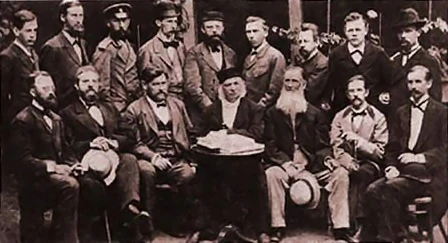
Henry Norris Russell
American astronomer who co-created the Hertzsprung–Russell diagram.
Henry Norris Russell was an American astronomer best known for independently creating the Hertzsprung–Russell diagram alongside Ejnar Hertzsprung in 1910, a foundational tool for understanding stellar evolution. He also developed Russell–Saunders coupling, or LS coupling, with Frederick Saunders in 1923. Born in Oyster Bay, New York, in 1877, Russell studied astronomy at Princeton University, earning his bachelor’s degree in 1897 and his doctorate in 1900 under Charles Augustus Young. After a period at the Cambridge Observatory with Arthur Robert Hinks and under the influence of George Darwin, he returned to Princeton, where he spent his entire career. He served as an instructor, assistant professor, professor, and research professor, and directed the Princeton University Observatory from 1912 to 1947. During his directorship, Charlotte Moore Sitterly assisted him in measuring and calculating stellar properties. Russell co-wrote a widely used two-volume astronomy textbook with Raymond Smith Dugan and John Quincy Stewart, which popularized the concept that a star’s radius, surface temperature, and luminosity are largely determined by its mass and chemical composition—a principle later known as the Vogt–Russell theorem. He initially discouraged Cecilia Payne-Gaposchkin from concluding that the Sun’s composition differed from Earth’s, but later acknowledged her correct finding. Russell received numerous honors, including the Gold Medal of the Royal Astronomical Society, the Henry Draper Medal, the Bruce Medal, and the Rumford Prize. He died in Princeton, New Jersey, in 1957 and is buried in Princeton Cemetery.
- field
- Astronomy
- nationality
- American
Lore & Background
Henry Norris Russell was an American astronomer, born in Oyster Bay, New York, who is best known for co-developing the Hertzsprung–Russell diagram in 1910. He also formulated Russell–Saunders coupling with Frederick Saunders in 1923. Russell studied at Princeton University, earning his bachelor’s degree in 1897 and his doctorate in 1900 under Charles Augustus Young. After working at the Cambridge Observatory with Arthur Robert Hinks, he returned to Princeton, serving as an instructor, assistant professor, professor, and research professor, and directing the Princeton University Observatory from 1912 to 1947. He married Lucy May Cole in 1908, and they had four children; their youngest daughter, Margaret, married astronomer Frank K. Edmondson. Russell co-wrote a two-volume astronomy textbook with Raymond Smith Dugan and John Quincy Stewart, which became a standard text for about two decades. This work popularized the Vogt–Russell theorem, which holds that a star’s properties are largely determined by its mass and chemical composition. Russell initially dissuaded Cecilia Payne-Gaposchkin from concluding that the Sun’s composition differs from Earth’s, but later confirmed her result and credited her discovery in his paper, though he did not share the fame or rewards he received for her work. He died in Princeton, New Jersey, in 1957 and is buried in Princeton Cemetery.
Reader's Guide
Henry Norris Russell’s most celebrated contribution to astronomy is the Hertzsprung–Russell diagram, which he developed alongside Ejnar Hertzsprung in 1910, a tool that remains fundamental for classifying stars and understanding their evolution. In 1923, working with Frederick Saunders, he devised Russell–Saunders coupling (also called LS coupling), a key concept in atomic physics. Russell’s influence extended through his teaching and writing: he served as a professor and later research professor at Princeton, where he also directed the university observatory from 1912 to 1947. With Raymond Smith Dugan and John Quincy Stewart, he co-authored a two-volume textbook in 1927 that became the standard astronomy text for roughly two decades. This work popularized the Vogt–Russell theorem, which holds that a star’s radius, surface temperature, and luminosity are largely determined by its mass and chemical composition, with stellar evolution resulting from gradual changes in composition. Russell’s career also involved a notable interaction with Cecilia Payne-Gaposchkin: he initially dissuaded her from concluding that the Sun’s composition differed from Earth’s, but later derived the same result himself and credited her discovery, though he did not share the subsequent fame.
Did You Know?
- Russell dissuaded Cecilia Payne-Gaposchkin from concluding the Sun's composition differed from Earth's, later realizing she was correct.
Frequently Asked Questions
Why is Henry Norris Russell considered important in the history of astronomy?
His co-creation of the H-R diagram gave the field a unifying visual framework for classifying stars and tracing their life cycles. His separate contribution of LS coupling also shaped how physicists describe electron interactions in multi-electron atoms, extending his influence well beyond pure observational astronomy.
More in Astronomers And Cosmologists 1-24
Spotted an error? Know more?
This is a living reference — every entry is fact-audited, and reader corrections feed straight into our audit queue. Suggest an edit · See this site's audit record