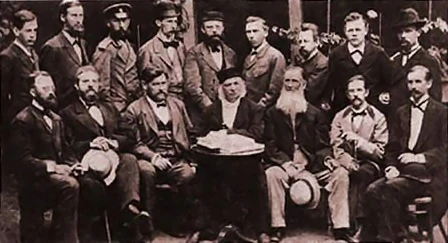
Henrietta Swan Leavitt
Discovered the period-luminosity relation for Cepheid variable stars.
Henrietta Swan Leavitt (July 4, 1868 – December 12, 1921) was an American astronomer whose work fundamentally altered humanity’s understanding of the universe’s scale. Born in Lancaster, Massachusetts, to a Congregational minister and his wife, she was a descendant of an early Puritan settler. Leavitt attended Oberlin College for two years before transferring to Radcliffe College, where she earned a bachelor’s degree in 1892 after studying a broad curriculum that included classical Greek, philosophy, and calculus. She then began working as a volunteer assistant at the Harvard College Observatory, one of the “computers” tasked with measuring photographic plates to catalog star positions and brightness. In 1902, director Edward Charles Pickering formally hired her, though she was initially unpaid due to her financial independence; she later received a modest hourly wage. Leavitt suffered from chronic illness and progressive hearing loss, eventually becoming deaf. Despite this, she was known as hard-working and deeply religious. Assigned to study variable stars in the Magellanic Clouds using plates from Peru, she identified 1,777 variable stars. In 1908, she published findings that brighter variables had longer periods. A 1912 paper, prepared by Leavitt but communicated by Pickering, examined 25 Cepheid variables in the Small Magellanic Cloud. She plotted magnitude against the logarithm of period and established a direct relationship between a Cepheid’s luminosity and its pulsation period, later called Leavitt’s Law. Since all stars in that cloud were roughly the same distance from Earth, the apparent brightness differences reflected true luminosity differences. This provided the first standard candle for measuring distances far beyond the reach of parallax. After her death, Edwin Hubble used Leavitt’s Law to find Cepheids in nebulae like Andromeda, proving they were separate galaxies and settling the Great Debate, then later combined it with redshifts to show the universe is expanding.
- died
- December 12, 1921
- field
- Astronomy
- nationality
- American
- known_for
- Discovery of the period-luminosity relationship for Cepheid variables (Leavitt's
Lore & Background
Henrietta Swan Leavitt discovered in 1908 the strong direct relationship between a classical Cepheid variable's luminosity and pulsation period. This relationship was used by Edwin Hubble for scaling galactic and extragalactic distances. Hubble proved that many objects previously thought to be nebulae were actually galaxies beyond the Milky Way by identifying Cepheid variables in the Andromeda Nebula and Triangulum Nebula, using Leavitt's Law to calculate their distances. Hubble's 1929 confirmation that a galaxy's recessional velocity increases with its distance from Earth, known as Hubble's law, also relied on distance measurements made possible by Leavitt's discovery. The Hubble Space Telescope was named in honor of Edwin Hubble.
Reader's Guide
Leavitt's Law, the period-luminosity relationship for Cepheid variables, became the essential tool for measuring cosmic distances. Edwin Hubble used it in 1924 to identify Cepheids in several nebulae, including the Andromeda Nebula and Triangulum Nebula. His observations proved these objects were entire galaxies far beyond the Milky Way, settling the debate about the universe's scale. Hubble later combined Leavitt's Law with redshift measurements from Vesto Slipher and Milton L. Humason to establish Hubble's law in 1929, showing the universe is expanding. Without Leavitt's discovery, Hubble could not have made these fundamental breakthroughs in extragalactic astronomy and observational cosmology.
Did You Know?
- Henrietta Swan Leavitt discovered the period-luminosity relationship for Cepheid variables in 1908.
- Edwin Hubble used Leavitt's Law to prove that the Andromeda Nebula and Triangulum Nebula were galaxies beyond the Milky Way.
- Hubble's 1929 discovery of the relationship between recessional velocity and distance relied on distance measurements made possible by Leavitt's work.
- Leavitt's discovery provided the first standard candle for measuring distances to other galaxies.
Frequently Asked Questions
Who is Henrietta Swan Leavitt?
Henrietta Swan Leavitt was an American astronomer (1868–1921) whose work on Cepheid variable stars transformed how scientists measure cosmic distances. She is widely regarded as one of the pivotal figures in early 20th-century observational astronomy.
What is Leavitt's Law?
Leavitt's Law states that a Cepheid variable star's pulsation period is directly tied to its intrinsic luminosity. The longer the star's cycle, the brighter it truly is, giving astronomers a reliable way to gauge how far away the star sits.
Why is Henrietta Swan Leavitt important?
Her period-luminosity relationship provided the astronomical community with a dependable 'standard candle' for measuring vast interstellar and intergalactic distances. That single insight fundamentally reshaped humanity's understanding of the size and structure of the universe.
What did Henrietta Swan Leavitt discover?
She identified a consistent mathematical link between the pulsation period of Cepheid variable stars and their true brightness. This relationship, now called Leavitt's Law, became one of the most essential tools in celestial distance measurement.
When and where was Henrietta Swan Leavitt born?
Leavitt was born on July 4, 1868, in Lancaster, Massachusetts. She died on December 12, 1921, at the age of fifty-three.
More in Astronomers And Cosmologists 1-24
Spotted an error? Know more?
This is a living reference — every entry is fact-audited, and reader corrections feed straight into our audit queue. Suggest an edit · See this site's audit record