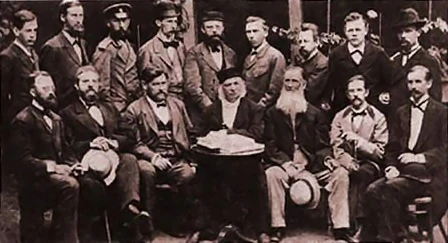
Giovanni Domenico Cassini
Italian-French astronomer who discovered four moons of Saturn and its ring division.
Giovanni Domenico Cassini (8-11 June 1625 – 14 September 1712) was an Italian-French mathematician, astronomer, astrologer and engineer. He is best known for discovering four satellites of Saturn and the division in its rings later called the Cassini Division, as well as creating the first scientific map of the Moon and beginning the topographic mapping of France.
Born in Perinaldo, near Imperia, then part of the Savoyard state, Cassini was the son of Jacopo Cassini and Giulia Crovesi. In 1648, he began his career at the Panzano Observatory near Bologna, working with Marquis Cornelio Malvasia. There, he completed his education under Giovanni Battista Riccioli and Francesco Maria Grimaldi. In 1650, the senate of Bologna appointed him principal chair of astronomy at the University of Bologna. During his time in Bologna, he observed the comet of 1652 and wrote a book about it. He also worked as a hydraulic engineer for the senate and, in 1657, was appointed inspector of fortifications by Pope Alexander VII, later becoming director of waterways in the papal states.
At the San Petronio Basilica in Bologna, Cassini convinced church officials to install an improved sundial meridian line. He moved the pinhole gnomon high into the church's vaults, 66.8 meters from the meridian on the floor. The resulting camera obscura projected a much larger image of the Sun's disk, allowing him to measure changes in its diameter over the year as Earth moved toward and away from the Sun. He concluded these changes matched Johannes Kepler's 1609 heliocentric theory—that Earth orbits the Sun in an elliptical path—rather than the Ptolemaic system. Cassini remained in Bologna until Colbert recruited him for the Paris Observatory, departing on 25 February 1669.
His fame grew from determining the rotational periods of Jupiter and Mars in 1665–1667. In 1669, with the Pope's reluctant consent, he moved to France. With a grant from Louis XIV, he helped establish the Paris Observatory, which opened in 1671; he served as its director for the rest of his life. For 41 years, he acted as astronomer and astrologer to the king, though he focused mostly on astronomy. He adopted his new country thoroughly, becoming known as Jean-Dominique Cassini. His method of determining longitude was used to measure France's size accurately for the first time; the country proved much smaller than expected, prompting the king to joke that Cassini had taken more of his kingdom than he had won in wars. On 14 July 1673, he became a French citizen. In 1674, he married Geneviève de Laistre, daughter of the lieutenant general of the comté of Clermont. They had two sons; the younger, Jacques Cassini, succeeded him as astronomer and geodesist. Cassini went blind in 1711 and died in Paris on 14 September 1712 at age 87.
As an astronomer, Cassini observed and published surface markings on Mars, determined the rotation periods of Mars and Jupiter, and discovered four satellites of Saturn: Iapetus and Rhea in 1671 and 1672, and Tethys and Dione in 1684. He called them Sidera Lodoicea (the stars of Louis). He correctly attributed Iapetus's unusual brightness variations to dark material on one hemisphere, now called Cassini Regio. In 1675, he discovered the Cassini Division in Saturn's rings. He shares credit with Robert Hooke for discovering Jupiter's Great Red Spot around 1665, and around 1690 he was the first to observe differential rotation in Jupiter's atmosphere. In 1672, he sent colleague Jean Richer to Cayenne, French Guiana, while staying in Paris; their simultaneous Mars observations allowed them to compute its distance from Earth via parallax, enabling the first estimate of the Solar System's dimensions. In 1677, philosopher John Locke visited Cassini in Paris, observing the Moon, Jupiter with its satellites, and Saturn with its rings and one satellite. Cassini initially believed Earth was the Solar System's center, but later observations led him to accept the models of Nicolaus Copernicus and eventually Tycho Brahe. In 1659, he presented a model of the planetary system.
- born
- 8-11 June 1625, Perinaldo, near Imperia, County of Nice, Savoyard state
- died
- 14 September 1712, Paris, France
- field
- Mathematics, astronomy, astrology, engineering
- nationality
- Italian-French
- known_for
- Discovery of four Saturnian satellites (Iapetus, Rhea, Tethys, Dione); Cassini D
Lore & Background
Cassini was born in Perinaldo, near Imperia, in the County of Nice, part of the Savoyard state. He was an Italian-French mathematician, astronomer, astrologer, and engineer. He discovered four satellites of Saturn and noted the division of its rings, later called the Cassini Division. He was the first of his family to begin work on a topographic map of France and also created the first scientific map of the Moon. Cassini observed and published surface markings on Mars, determined the rotation periods of Mars and Jupiter, and discovered the Saturnian moons Iapetus, Rhea, Tethys, and Dione. He correctly ascribed Iapetus’s brightness variations to dark material on one hemisphere. He shares credit with Robert Hooke for discovering the Great Red Spot on Jupiter and was the first to observe differential rotation within Jupiter’s atmosphere. In 1672, he sent Jean Richer to Cayenne while he stayed in Paris; their simultaneous Mars observations allowed the first estimation of the Solar System’s dimensions. Cassini also measured the size of France accurately for the first time using his longitude method.
Reader's Guide
Cassini's significance lies in his foundational contributions to planetary astronomy and geodesy. His discovery of four Saturnian moons and the Cassini Division greatly expanded knowledge of the Saturn system, and his method of determining longitude via eclipses of Jupiter's moons enabled the first accurate measurement of France's size. His work on the rotation periods of Jupiter and Mars, and his observation of differential rotation in Jupiter's atmosphere, advanced understanding of planetary dynamics. His legacy includes the first scientific map of the Moon and the beginning of the topographic map of France, a project continued by his family.
Did You Know?
- Cassini created an improved sundial meridian line at San Petronio Basilica using a pinhole gnomon 66.8 meters from the floor.
- He shared credit with Robert Hooke for discovering the Great Red Spot on Jupiter.
Frequently Asked Questions
Who is Giovanni Domenico Cassini?
Giovanni Domenico Cassini was an Italian-French polymath active in the 17th and early 18th centuries, working across mathematics, astronomy, astrology, and engineering. Born in 1625 in Perinaldo near Imperia and dying in 1712 in Paris, he bridged two national scientific traditions.
What are Giovanni Domenico Cassini's most famous discoveries?
He identified four moons of Saturn—Tethys, Dione, Rhea, and Iapetus—and noticed a gap in the planet's rings that later bore his name. He also produced the first scientifically rigorous map of the Moon's surface.
How did Giovanni Domenico Cassini's career span two countries?
Cassini began his work in Italy before relocating to France, where he joined the Paris Observatory under Louis XIV. He spent the latter half of his life in France, where he also undertook the first systematic topographic survey of the country.
What is the Cassini Division?
It is the prominent gap visible in Saturn's ring system that Cassini first observed in the late 1600s. The division separates the brighter B ring from the A ring and remains one of the most recognizable features in the solar system.
Why is Giovanni Domenico Cassini important in astronomy history?
His Saturn observations fundamentally expanded humanity's catalog of the planet's moons and revealed structural detail in its rings for the first time. His lunar cartography set a standard for scientific mapping that influenced generations of astronomers.
More in Astronomers And Cosmologists 1-24
Spotted an error? Know more?
This is a living reference — every entry is fact-audited, and reader corrections feed straight into our audit queue. Suggest an edit · See this site's audit record