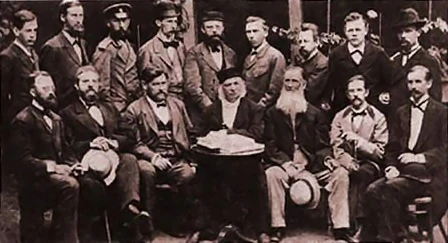
Ejnar Hertzsprung
Danish astronomer who co-created the Hertzsprung–Russell diagram.
Ejnar Hertzsprung was a Danish chemist and astronomer, best remembered for his role in developing the Hertzsprung–Russell diagram, a fundamental tool for classifying stars by spectral type, stage in their development, and luminosity. Born in Frederiksberg, Denmark, he initially studied chemical engineering at the Copenhagen Polytechnic Institute, graduating in 1898. After working as a chemist in St. Petersburg for two years, he studied photochemistry at Leipzig University for a year in 1901. His father, an amateur astronomer, sparked his interest in the field, and Hertzsprung began making astronomical observations in Frederiksberg in 1902. Within a few years, he observed that stars of similar spectral type could have vastly different absolute magnitudes. In 1909, he joined the Göttingen Observatory under Karl Schwarzschild. He developed the Hertzsprung–Russell diagram in 1911, independently of Henry Norris Russell, who created a similar diagram in 1913. In 1913, Hertzsprung used parallax to determine distances to several Cepheid variable stars, calibrating the period-luminosity relationship discovered by Henrietta Leavitt, though a mistake in his calculations placed the stars ten times too close. He applied this relationship to estimate the distance to the Small Magellanic Cloud. From 1919 to 1946, he worked at Leiden Observatory in the Netherlands, serving as director from 1937, where his graduate students included Gerard Kuiper. Hertzsprung also discovered two asteroids, including the Amor asteroid 1627 Ivar. He married Henrietta, daughter of Dutch astronomer Jacobus Kapteyn, and died in Roskilde in 1967.
- field
- Astronomy
Lore & Background
Ejnar Hertzsprung was a Danish chemist and astronomer, born in Frederiksberg to Severin and Henriette. His father’s amateur astronomical work sparked his own interest in the subject. After studying chemical engineering at Copenhagen Polytechnic Institute and working as a chemist in St. Petersburg, he spent a year studying photochemistry at Leipzig University. He began making astronomical observations in Frederiksberg in 1902, and within a few years noticed that stars of similar spectral type could have widely different absolute magnitudes. In 1909, he took a position at the Göttingen Observatory under Karl Schwarzschild. Hertzsprung is best remembered for developing the Hertzsprung–Russell diagram, a classification system for stars based on spectral type, stage of development, and luminosity, which he created in 1911, independently of Henry Norris Russell in 1913. He used Antonia Maury’s earlier classification system in his work. In 1913, he determined distances to several Cepheid variable stars by parallax, calibrating the period-luminosity relationship discovered by Henrietta Leavitt, though a mistake made the stars appear ten times too close. He used this to estimate the distance to the Small Magellanic Cloud. From 1919 to 1946, he worked at Leiden Observatory, serving as director from 1937. Among his graduate students was Gerard Kuiper. He also discovered two asteroids, including 1627 Ivar. He married Henrietta, daughter of astronomer Jacobus Kapteyn, and died in Roskilde in 1967.
Reader's Guide
Ejnar Hertzsprung’s most significant scientific achievement was the creation of a stellar classification scheme that sorted stars according to their spectral type, evolutionary stage, and luminosity. This system built upon the earlier classification work of Antonia Maury. The resulting diagram, now known as the Hertzsprung–Russell diagram, became a cornerstone of astrophysics, used continuously to interpret stellar types and the processes of stellar evolution. Hertzsprung’s path to this discovery began with his early astronomical observations in Frederiksberg, where he noticed that stars of the same spectral type could possess vastly different absolute magnitudes. This insight led him to develop the diagram in 1911, a concept independently arrived at by Henry Norris Russell in 1913. Beyond this diagram, Hertzsprung made other notable contributions. In 1913, he used parallax to measure distances to several Cepheid variable stars, calibrating the period-luminosity relationship discovered by Henrietta Leavitt, though a calculation error placed the stars ten times too close. He then applied this relationship to estimate the distance to the Small Magellanic Cloud. During his long tenure at Leiden Observatory, where he served as director from 1937, he mentored students including Gerard Kuiper. He also discovered two asteroids, among them the Amor asteroid 1627 Ivar. His work fundamentally reshaped how astronomers classify and understand stars, linking their spectral properties directly to their intrinsic brightness and life cycles.
Did You Know?
- By 1908, Danish astronomer Ejnar Hertzsprung had realized the value of Antonia Maury's classifications and used them in his system of identifying very bright red giant stars from faint dwarf stars.
- Hertzsprung wrote to Pickering: 'In my opinion the separation by Antonia Maury of the c-and ac stars is the most important advancement in stellar classification since the trials by Vogel and Secchi.'
- In 1922, the International Astronomical Union modified its classification system based on work done by Maury and Hertzsprung, a formulation known as the Hertzsprung–Russell diagram.
Frequently Asked Questions
Who is Ejnar Hertzsprung?
He was a Danish chemist who turned to astronomy and became a central figure in early stellar classification. He is best known for co-developing the H-R diagram alongside Henry Norris Russell in the early 1900s.
What is the Hertzsprung–Russell diagram and why does it matter?
It is a scatter plot that maps stars by spectral temperature against luminosity, revealing distinct clusters that correspond to different evolutionary stages. Hertzsprung and Russell independently created this framework, and it remains the primary visual tool for organizing stellar life cycles.
What did Hertzsprung contribute to Cepheid variable research?
He developed techniques for measuring the distances to Cepheid variable stars, helping establish them as reliable standard candles. His distance work laid groundwork that later enabled astronomers to gauge the scale of the universe.
Why is Ejnar Hertzsprung considered important to modern astronomy?
His classification scheme gave the field a single, intuitive chart for understanding how stars are born, evolve, and die. Without the H-R diagram, the modern picture of stellar evolution would lack its central organizing reference.
Did Hertzsprung discover anything beyond stellar patterns?
Yes—he identified one asteroid during his observational work. However, his lasting legacy is overwhelmingly tied to stellar classification and distance measurement rather than individual object discoveries.
More in Astronomers And Cosmologists 1-24
Spotted an error? Know more?
This is a living reference — every entry is fact-audited, and reader corrections feed straight into our audit queue. Suggest an edit · See this site's audit record